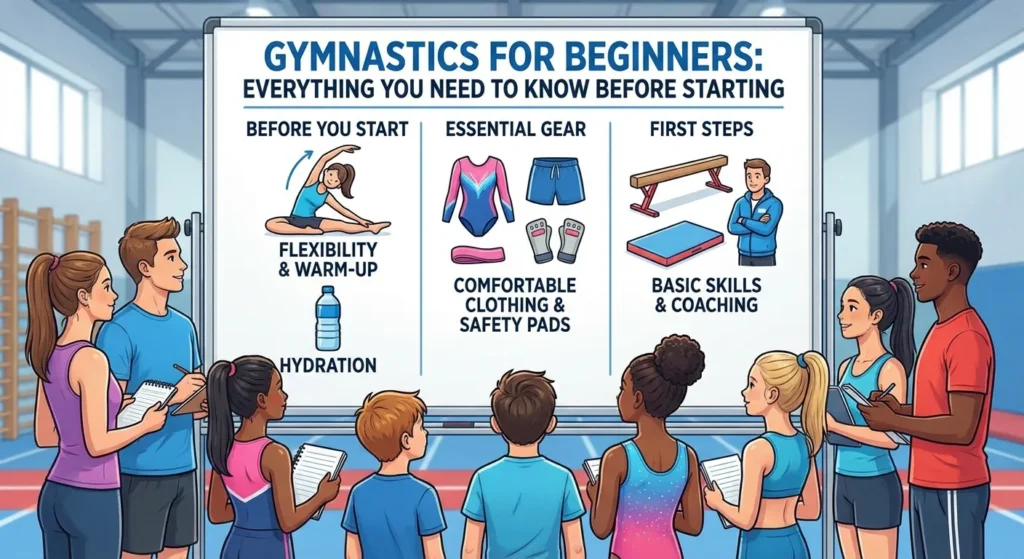
Gymnastics for Beginners: Complete Guide to Starting
Starting gymnastics can feel exciting — and a little overwhelming.
You may be wondering:
What age can a child start gymnastics? Is gymnastics safe? What should beginners learn first? What should they wear? How often should they train? Do they need equipment at home? And what if they have never done gymnastics before?
The good news is that you do not need to be flexible, strong, or experienced to start.
A good beginner gymnastics program is designed to teach the fundamentals step by step. You do not need to know how to do a back handspring or hold a perfect handstand before your first class.
You simply need to start at the appropriate level and learn the basics correctly.
In this guide, you will learn what beginners should know before starting gymnastics, including age, classes, skills, clothing, training frequency, safety, home practice, equipment, and how gymnastics can develop over time.
What Is Gymnastics?
Gymnastics is a sport based on movement, strength, flexibility, balance, coordination, body control, and spatial awareness.
There are several disciplines within gymnastics, including:
Artistic gymnastics
Rhythmic gymnastics
Trampoline and tumbling
Acrobatic gymnastics
Aerobic gymnastics
For most children and adults who are completely new to the sport, recreational gymnastics is the most common starting point.
Recreational programs are generally designed for beginners and can include participants ranging from preschool children to adults.
For beginners, the goal is not to learn impressive tricks immediately.
The goal is to build a strong foundation.
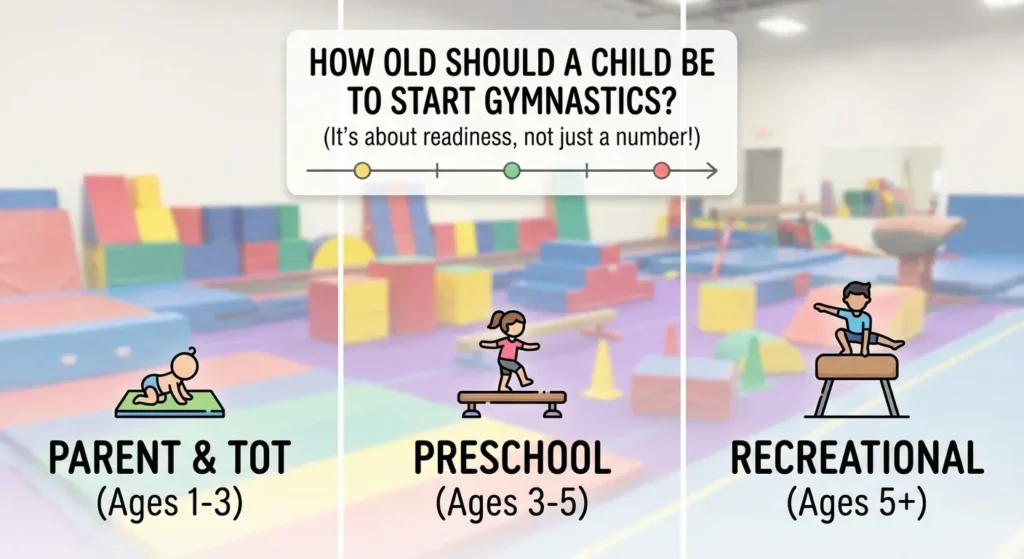
What Age Can You Start Gymnastics?
One of the most common questions parents ask is:
“Is my child too young or too old to start gymnastics?”
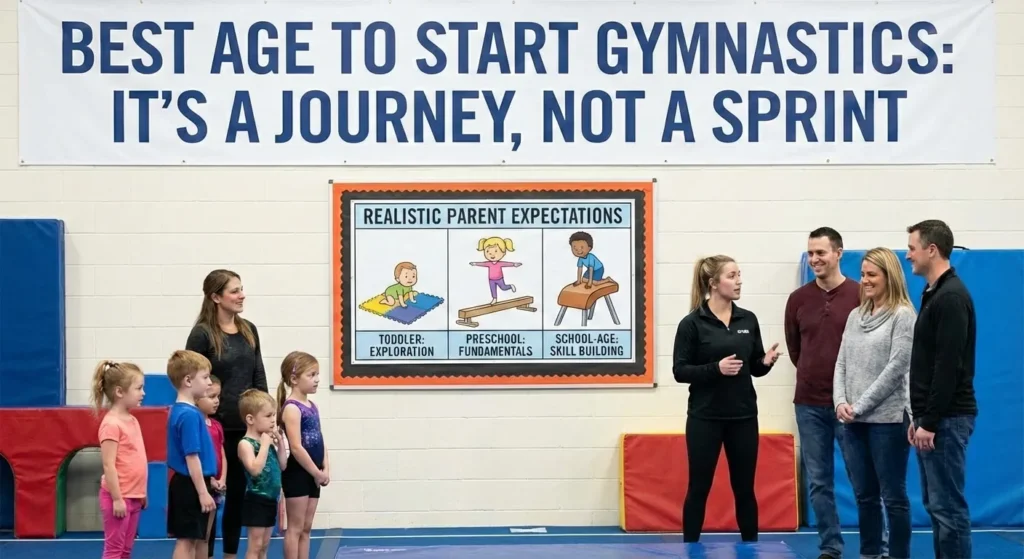
In most cases, there is no single age that is considered the “correct” age to begin.
The type of class should simply match the athlete’s age, development, and experience.
If you’re specifically trying to decide when your child should start, see our detailed guide:
What Is the Best Age to Start Gymnastics?
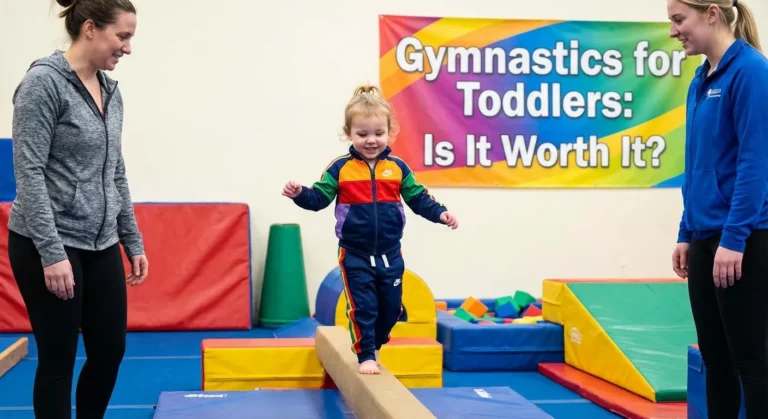
Gymnastics for Toddlers and Preschoolers
Young children may participate in parent-and-child or preschool gymnastics programs.
These classes usually focus on:
Balance
Jumping
Climbing
Basic coordination
Following directions
Body awareness
Simple movement patterns
At this age, gymnastics should be fun and developmentally appropriate rather than focused on difficult skills.
Gymnastics for Children
Children can begin recreational gymnastics without previous experience.
Beginner classes may introduce:
Forward rolls
Backward rolls
Cartwheel progressions
Handstand progressions
Jumps and safe landings
Basic flexibility
Strength and body positions
Children do not need to be naturally flexible or athletic before starting.
Those qualities can develop through appropriate training.
Gymnastics for Older Children and Teenagers
Starting later does not mean a gymnast cannot make progress.
An older beginner may learn many of the same fundamentals while progressing according to their individual strength, mobility, coordination, and confidence.
Competitive pathways can have different age and skill requirements, but recreational gymnastics is much more flexible.
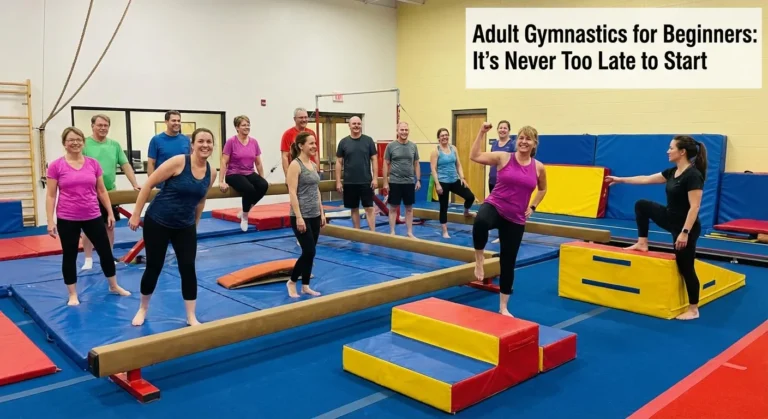
Can Adults Start Gymnastics?
Absolutely.
Adult gymnastics can be used for fitness, mobility, strength, coordination, skill development, or simply learning something new.
Adults may start with basic skills such as:
Rolls
Handstands
Cartwheels
Bridges
Balance exercises
Basic swings
Strength and conditioning
If you’re an adult thinking about starting gymnastics, read our complete guide:
Adult Gymnastics for Beginners: It’s Never Too Late to Start
What Happens in a Beginner Gymnastics Class?
If you have never been to a gymnastics gym before, you may imagine that beginners immediately start practicing flips.
That is usually not how a good beginner class works.
A typical class may include:
1. Warm-Up
The class begins with movements designed to prepare the body for training.
This may include:
Light jogging
Skipping
Jumping
Arm movements
Leg swings
Dynamic mobility
Basic coordination exercises
2. Strength and Body Positions
Beginners learn basic positions that appear repeatedly throughout gymnastics.
These may include:
Tuck
Pike
Straddle
Straight
Hollow
Arch
Simple conditioning exercises may also be introduced.
3. Skill Stations
Gymnastics classes often rotate between different stations.
For example, a beginner may work on:
Floor exercises
Balance beam
Bars
Vault drills
Trampoline or tumble drills
Strength activities
4. Cool-Down and Flexibility
The class may finish with flexibility exercises and a review of skills.
The important thing to remember is that beginners are not expected to know everything on their first day.
The coach’s job is to teach the skills progressively.
For a more detailed look at what happens during beginner classes, read:
Beginner Gymnastics Classes: What to Expect
What Skills Do Gymnastics Beginners Learn First?
Beginners should focus on fundamental skills before moving to advanced gymnastics.
Some common beginner skills include:
Rolls
Forward and backward rolls teach athletes how to control their body while moving through different positions.
Handstands
Beginners may start with body-position drills, wall-supported handstands, or coach-assisted progressions.
Cartwheels
Cartwheels introduce weight transfer, coordination, hand placement, and body control.
Jumps and Landings
Learning how to land with control is one of the most important foundations in gymnastics.
Beginners may practice:
Two-foot landings
Stick landings
Jumping drills
Body positioning
Balance after landing
Balance
Walking and balancing on low or floor-level equipment helps beginners develop control and confidence.
Basic Strength
Gymnastics requires strength throughout the body.
Beginners may work on:
Core strength
Leg strength
Shoulder strength
Arm strength
Grip strength
Flexibility
Flexibility is developed gradually.
Common areas include:
Hamstrings
Hips
Shoulders
Ankles
Back
A beginner should not force a split or another flexibility position simply because another gymnast can do it.
Do You Need to Be Flexible to Start Gymnastics?
No.
You do not need to be flexible before starting gymnastics.
Flexibility is one of the physical qualities that can be developed through appropriate training.
A beginner may initially have:
Tight hamstrings
Limited shoulder mobility
Limited hip flexibility
Difficulty sitting in a pike
Difficulty holding certain gymnastics positions
That is normal.
The important thing is to improve gradually rather than forcing range of motion.
Flexibility should be developed with proper technique and after the body is appropriately warmed up.
Do You Need to Be Strong to Start Gymnastics?
You also do not need to be strong before your first class.
Gymnastics training itself helps develop strength.
Beginners may start with simple exercises such as:
Squats
Lunges
Push-ups or modified push-ups
Planks
Hollow-body exercises
Leg lifts
Basic hanging exercises
As strength improves, more difficult gymnastics skills become possible.
This is one reason why beginners should not rush directly into advanced skills.
The body needs time to develop the strength and control required for them.
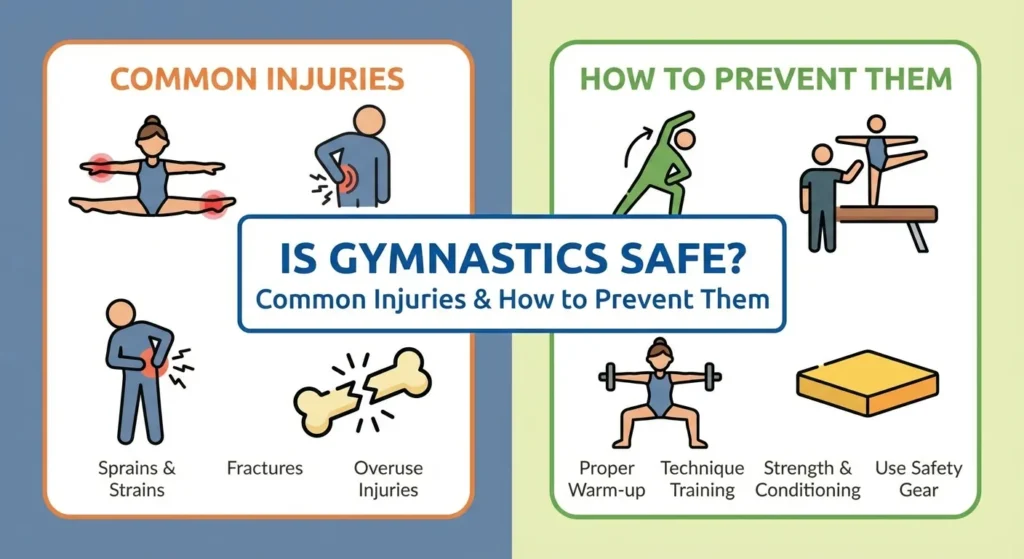
Is Gymnastics Safe for Beginners?
Gymnastics involves physical activity, and like other sports, injuries can occur.
The goal is not to eliminate all risk. The goal is to create an environment where beginners learn appropriate skills progressively and safely.
A quality beginner program should emphasize:
Proper warm-ups
Age-appropriate instruction
Progressive skill development
Appropriate equipment
Suitable mats
Qualified coaching
Supervision
Proper technique
Adequate recovery
Beginners should not be pressured into skills they are not prepared to perform.
One of the biggest mistakes is trying to progress faster than the athlete’s preparation allows.
For a detailed explanation of common gymnastics injuries and safety considerations, read:
Is Gymnastics Safe? Common Injuries & How to Prevent Them
You can also read:
How to Prevent Injuries in Gymnastics
How Often Should a Beginner Train Gymnastics?
There is no single schedule that works for every beginner.
Recreational programs can vary considerably in frequency and class length depending on the gym, age group, and program.
For many beginners, one or two classes per week can be a practical starting point.
As the gymnast develops and their goals change, training frequency may increase.
Competitive gymnasts generally train more frequently than recreational participants.
The important factors are:
Consistency
Recovery
Age
Training goals
Physical readiness
Quality of instruction
More training is not automatically better.
A beginner needs time to adapt to the physical demands of gymnastics.
For a more detailed breakdown of training frequency, see:
How Many Hours a Week Should a Gymnast Train?
What Should a Beginner Wear for Gymnastics?
Gymnastics clothing should allow unrestricted movement without creating unnecessary hazards.
For girls, a leotard is common.
For boys, fitted athletic shorts or athletic clothing are commonly used.
Depending on the gym, appropriate clothing may include:
Leotard
Fitted athletic shirt
Athletic shorts
Fitted athletic pants
Gymnasts generally train barefoot unless the facility or program specifies otherwise.
Avoid:
Jewelry
Loose clothing
Clothing with hard objects
Anything that could catch on equipment
Long hair should generally be secured away from the face.
Before the first class, check the gym’s specific dress requirements because policies vary.
What Should You Bring to Your First Gymnastics Class?
You usually do not need a large equipment bag.
For a beginner class, consider bringing:
Comfortable gymnastics clothing
Water bottle
Hair ties if needed
A small towel if desired
Any paperwork required by the gym
Most gymnastics facilities provide the equipment needed for class.
Parents often buy unnecessary equipment before knowing what their child actually needs.
Start with the class first.
Once you understand your child’s program and goals, you can decide whether home equipment makes sense.
For a complete parent checklist, read:
What Should Parents Bring to Gymnastics? A Complete Beginner’s Checklist
Does a Beginner Need Gymnastics Equipment at Home?
Usually, no.
A beginner can learn a tremendous amount during structured gymnastics classes without owning specialized equipment.
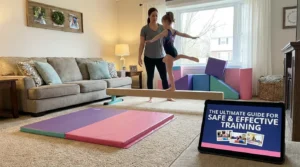
If you eventually want to support basic training at home, simple equipment may be useful.
For example:
Folding gymnastics mat
Low or floor balance beam
Resistance bands
Basic conditioning equipment
The purpose of home equipment should be to support safe foundational training — not to replace professional coaching.
Advanced equipment such as high beams, full-size bars, vaulting equipment, or improperly installed apparatus can create unnecessary risks in a home environment.
Before buying anything, consider the athlete’s age, skill level, available space, and training goals.
For detailed beginner equipment recommendations, see:
Best Gymnastics Equipment for Beginners: 10 Must-Have Products
For a more detailed home-training setup, read:
Gymnastics Equipment for Home: The Ultimate Guide
Can Beginners Practice Gymnastics at Home?
Yes — but home practice should be limited to skills and exercises that are appropriate for the athlete’s current level.
Good examples may include:
Basic stretching
Core exercises
Squats and lunges
Body-position drills
Balance exercises
Conditioning
Flexibility work
Simple handstand preparation when appropriately supervised
Beginners should not attempt advanced tumbling skills, flips, or other difficult skills without appropriate coaching and equipment.
A home session should complement gymnastics classes, not replace them.
For a complete guide to setting up a safe home practice area, see:
Gymnastics Equipment for Home: The Ultimate Guide for Safe & Effective Training
How Long Does It Take to Learn Gymnastics?
There is no universal timeline.
One beginner may develop a handstand quickly but struggle with flexibility.
Another may have excellent flexibility but need more time to develop strength.
Progress depends on factors such as:
Age
Previous physical activity
Strength
Flexibility
Coordination
Training frequency
Coaching
Consistency
Confidence
Individual development
Instead of asking:
“How quickly can I learn a back handspring?”
a better question is:
“Am I building the skills and physical preparation needed to learn it safely?”
Gymnastics is a progression-based sport.
Strong fundamentals make advanced skills easier to learn later.
Recreational vs. Competitive Gymnastics
Not every gymnast needs to compete.
Recreational Gymnastics
Recreational gymnastics is generally focused on:
Learning skills
Fitness
Coordination
Strength
Flexibility
Confidence
Having fun
It can be a long-term activity without competition.
Competitive Gymnastics
Competitive gymnastics requires additional commitment.
Depending on the program, athletes may have:
More training hours
More structured skill requirements
Competitions
Routine preparation
Evaluations
Greater physical demands
If your child begins asking about competitive gymnastics, understanding the different pathways can be helpful.
Gymnastics Levels Explained: USAG, Xcel & FIG
Parents should not assume that every child who starts recreational gymnastics needs to become competitive.
The best path depends on the athlete’s interests, goals, development, and the program available to them.
What Are the Most Common Beginner Gymnastics Mistakes?
Beginners often make the same mistakes.
1. Trying Advanced Skills Too Soon
A skill may look simple when performed by an experienced gymnast.
The preparation behind that skill is usually much more complicated.
2. Comparing Yourself to Other Gymnasts
Two athletes can start at the same age and progress at completely different rates.
Comparison can create unnecessary pressure.
Focus on your own improvement.
3. Ignoring Strength
Flexibility alone does not make a gymnast.
Strength and body control are equally important.
4. Forcing Flexibility
Stretching should be controlled.
Pain is not a requirement for flexibility development.
5. Training Too Much
Rest and recovery are part of training.
More practice is not always better if the athlete is tired or not recovering properly.
6. Practicing Advanced Skills Without a Coach
Watching a skill online does not mean you are prepared to perform it.
Gymnastics skills should be learned through appropriate progressions.
How Can Parents Help a Beginner Gymnast?
Parents play an important role in a young gymnast’s development.
But there is an important distinction:
Your job is to support your child — not to become their coach.
Parents can help by:
Getting the child to practice consistently
Encouraging effort
Supporting healthy habits
Listening to the coach
Allowing appropriate rest
Avoiding comparisons
Celebrating small improvements
Helping the child maintain a positive attitude
Try not to make every class about whether your child learned a new skill.
Sometimes progress looks like:
Better body position
Better balance
More confidence
Better listening
Improved strength
Less fear
Better technique
Those improvements are important too.
What If My Child Is Afraid of Gymnastics?
Fear is common for beginners.
Being upside down, jumping from equipment, hanging from bars, or learning to land can feel unfamiliar.
A good coach should introduce new movements progressively.
Children should be allowed to build confidence rather than being pushed aggressively through fear.
Parents can help by staying positive and avoiding statements that make the child feel that being afraid is a failure.
Confidence usually grows as the gymnast becomes more familiar with the equipment and movements.
How Do You Choose a Gymnastics Program?
Choosing the right gym is an important part of starting gymnastics.
Before enrolling, consider:
Coaching
Ask about coach experience, training, and how beginner classes are structured.
Supervision
Beginners should receive appropriate supervision and instruction.
Equipment
Look for equipment that is properly maintained and appropriate for the age and level of the athletes.
Class Size
Smaller groups may allow more individual attention, although class size varies by program.
Progression
Ask how athletes move from beginner skills to more advanced skills.
Communication
A good program should communicate clearly with parents about schedules, expectations, progress, and safety.
Atmosphere
Watch how coaches interact with athletes.
You want a program where beginners can learn without unnecessary pressure.
A Simple Beginner Gymnastics Roadmap
If you are starting from zero, think about gymnastics in stages.
Stage 1: Movement
Learn:
Basic coordination
Balance
Jumps
Landings
Rolls
Stage 2: Body Control
Develop:
Hollow position
Arch position
Tuck
Pike
Straight body position
Stage 3: Strength and Flexibility
Build:
Core strength
Upper-body strength
Leg strength
Shoulder mobility
Hip flexibility
Hamstring flexibility
Stage 4: Foundational Skills
Work toward:
Handstands
Cartwheels
Bridges
Basic bar skills
Balance skills
Basic vaulting movements
Stage 5: Advanced Skills
Only after the necessary foundations are developed should a gymnast begin progressing toward more advanced skills.
The exact progression depends on the athlete and their coach.
Beginner Gymnastics at Home: A Simple Weekly Plan
If you want to supplement gymnastics classes at home, keep the sessions short and simple.
For example:
Monday — Strength
Squats
Lunges
Planks
Hollow hold
Push-ups
Wednesday — Flexibility
Hamstring mobility
Hip flexibility
Shoulder mobility
Gentle stretching
Friday — Body Control
Hollow position
Arch position
Balance
Basic coordination drills
Weekend — Rest or light activity
This is only an example.
A gymnast’s actual home program should be appropriate for their age, skill level, training schedule, and coach’s recommendations.
For more ideas about safe home training and equipment, see:
Gymnastics Equipment for Home: The Ultimate Guide for Safe & Effective Training
Frequently Asked Questions About Gymnastics for Beginners
Is gymnastics hard for beginners?
Gymnastics can be physically challenging, but beginners do not start with advanced skills. Good programs introduce movements progressively and adjust activities according to age and ability.
Can a child start gymnastics with no experience?
Yes. Recreational gymnastics commonly includes complete beginners, and previous experience is generally not required for entry-level programs.
Is gymnastics good for kids?
Gymnastics can help children develop physical qualities such as strength, coordination, balance, flexibility, and body awareness while also teaching them how to follow instructions and practice skills progressively.
Can adults learn gymnastics?
Yes. Adults can start with basic gymnastics skills and gradually develop strength, flexibility, coordination, and technique.
Adult Gymnastics for Beginners: It’s Never Too Late to Start
What is the easiest gymnastics skill to learn?
There is no single easiest skill for everyone. Basic rolls, jumps, landings, balance exercises, and body positions are common starting points.
Do I need gymnastics equipment at home?
No. Most beginners can start without home equipment because gymnastics facilities provide the equipment needed for classes. Basic home equipment can be added later if it supports the athlete’s training safely.
Best Gymnastics Equipment for Beginners: 10 Must-Have Products
How many days a week should a beginner do gymnastics?
It depends on the athlete and the program. Recreational gymnastics schedules vary by gym, age group, and goals.
For a deeper explanation of training frequency:
How Many Hours a Week Should a Gymnast Train?
What should I wear to gymnastics?
Wear comfortable, fitted athletic clothing or a leotard, depending on the program. Avoid jewelry and loose clothing, and check the gym’s specific dress code.
Can gymnastics be practiced at home?
Basic conditioning, flexibility, balance, and other appropriate exercises can be practiced at home. Advanced skills should be learned under qualified coaching with appropriate equipment and supervision.
Free Beginner Gymnastics Starter Kit
If you are completely new to gymnastics, you may also want a simple plan to help you understand what to practice and how to build your foundation.
Get the Free Gymnastics Beginner Starter Kit and use it as a simple starting point for:
Beginner skill development
Strength
Flexibility
Body positions
Weekly practice
Warm-up and safety
Parent and athlete tips
→ GET THE FREE BEGINNER STARTER KIT
Final Thoughts: Starting Gymnastics the Right Way
Starting gymnastics does not require perfect flexibility, impressive strength, or previous experience.
You do not need to know how to do a back handspring before your first class.
You do not need expensive equipment.
And you do not need to compare your progress with another gymnast.
What you need is a good foundation, appropriate coaching, consistent practice, and patience.
Start with the basics.
Learn how to move.
Build strength.
Develop flexibility gradually.
Learn how to land safely.
Improve your balance and body control.
Then progress to more difficult skills when you are ready.
Gymnastics is not about how quickly you can learn the hardest skill. It is about building the foundation that allows you to keep learning.
Whether you are a parent enrolling your child in their first gymnastics class or an adult finally deciding to try the sport yourself, the most important step is simple:
Start where you are, learn the fundamentals, and enjoy the process.
About the Author
Andrey Sovenko
Andrey Sovenko is a former Russian National Team gymnast, gymnastics coach, and gymnastics club owner with more than two decades of experience in gymnastics.
He competed as a member of the Russian National Gymnastics Team from 2003 to 2008 and later worked continuously as a gymnastics coach in the United States from 2014 through 2026.
From 2016 to 2023, Andrey founded and operated a gymnastics facility serving approximately 500 students with a team of approximately 10 employees.
Through Gymnastics Guide, he shares practical information about gymnastics skills, training, equipment, safety, beginner development, and the sport’s competitive pathways.
Learn More About Andrey Sovenko
Affiliate Disclosure
As an Amazon Associate, I earn from qualifying purchases.
Some articles on Gymnastics Guide contain affiliate links. If you purchase a product through one of these links, I may earn a commission at no additional cost to you.
Product prices, availability, specifications, and sellers can change, so always verify current information before purchasing. For gymnastics equipment, always follow the manufacturer’s instructions, weight limits, and safety recommendations.