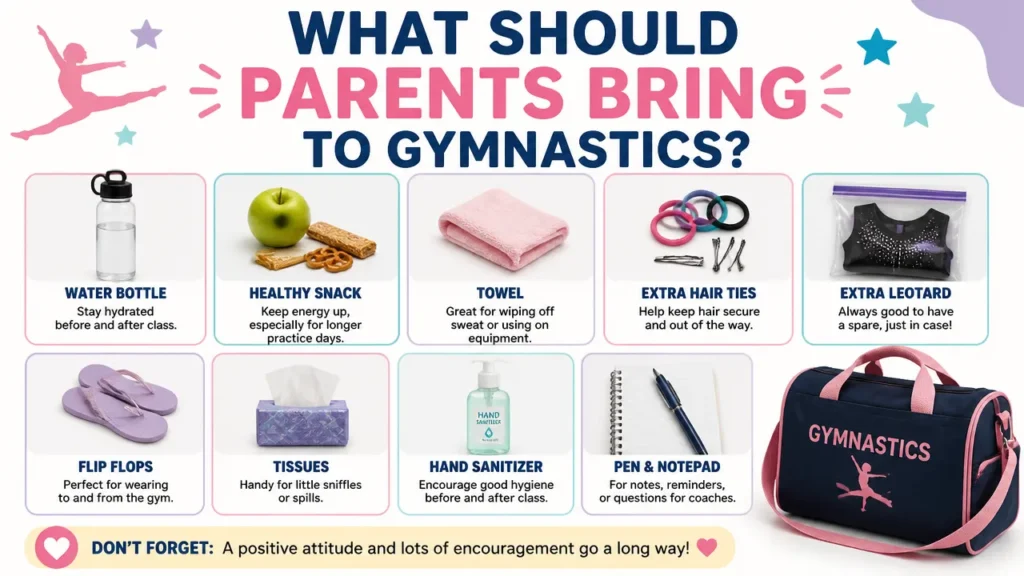
What Should Parents Bring to Gymnastics? A Complete Beginner’s Checklist
Starting gymnastics can be exciting for both children and parents. But before the first class, many parents have the same questions:
What should my child wear? Do they need gymnastics shoes? Should I bring a water bottle? What about snacks, grips, or special equipment?
The good news is that preparing for gymnastics is usually much simpler than it seems.
For most beginner and recreational gymnastics classes, your child does not need expensive equipment or a large collection of specialized gear. The most important things are comfortable clothing, water, secured hair, and a positive attitude.
However, knowing what to bring — and what to leave at home — can make your child’s first gymnastics experience much easier.
This guide provides a complete gymnastics parent checklist, including what to bring to the first class, what children should wear, what parents should know about safety, and what to pack for longer practices and competitions.
Quick answer: Most beginner gymnasts need comfortable athletic clothing or a leotard, a water bottle, secured hair, and any forms required by the gymnastics club. Jewelry and unnecessary personal equipment should generally be left at home.
Gymnastics Parent Checklist: What to Bring
Before leaving for gymnastics, use this simple checklist.
Essential Items
Comfortable gymnastics clothing
Water bottle
Hair ties or other appropriate hair accessories
Gym bag
Any required registration or medical forms
Helpful Items
Small snack for longer training sessions
Extra hair ties
Small towel
Change of clothes
Hand sanitizer
Usually Not Necessary
Gymnastics shoes
Personal gymnastics equipment
Jewelry
Toys
Large meals immediately before practice
Grips unless recommended by the coach
Your gymnastics club may have its own policies, so always follow the instructions provided by the gym.
What Should a Child Wear to Gymnastics?
One of the most important things to prepare is appropriate training clothing.
Gymnastics involves a lot of movement, including rolling, jumping, climbing, hanging, balancing and tumbling. Clothing should allow the gymnast to move freely without getting in the way.
Common choices include:
Gymnastics leotard
Fitted athletic shorts
Fitted leggings
Athletic shirt
Other comfortable gymnastics practice clothing
The exact dress code depends on the gymnastics program.
Some gyms require a leotard, while recreational programs may allow fitted athletic clothing.
What makes good gymnastics clothing?
Look for clothing that:
Allows unrestricted movement
Fits securely
Does not have loose straps
Does not contain bulky accessories
Allows the coach to see body position
Is comfortable during movement
For a beginner, you do not need to spend a lot of money on competition-quality clothing.
Comfort, fit and freedom of movement are more important than having the most expensive leotard.
USA Gymnastics rules also emphasize appropriate attire and keeping hair secured away from the face during gymnastics activities.
Does My Child Need a Leotard?
Not necessarily.
A leotard is traditional gymnastics clothing and is commonly worn by gymnasts, particularly in structured programs and competitions.
However, many recreational gymnastics programs allow children to wear fitted athletic clothing.
Before buying a leotard specifically for the first class, check the gym’s dress code.
If you’re not sure, simply ask:
“What should my child wear for their first gymnastics class?”
The gym will usually tell you exactly what is expected.
Does My Child Need Gymnastics Shoes?
Usually, no.
Many gymnastics activities are performed barefoot.
Gymnastics shoes are not generally something parents need to purchase before a child starts recreational gymnastics.
Your child’s gym may have specific requirements for certain classes, so check with the facility before buying specialized footwear.
Parent tip
Don’t buy gymnastics shoes simply because they are advertised as “gymnastics shoes.”
Your child may never need them.
Bring a Water Bottle
A water bottle should be one of the first things you put in your child’s gymnastics bag.
Gymnastics classes involve physical activity, and athletes need access to fluids during training.
USA Gymnastics includes water bottles among recommended items for athletes attending training activities.
The American Academy of Pediatrics also emphasizes hydration as an important part of sports participation, particularly during longer or more demanding physical activity.
What should you look for in a gymnastics water bottle?
Choose one that is:
Leak-resistant
Easy for your child to open
Durable
Easy to identify
Appropriate for the length of the training session
A simple reusable bottle is usually enough.
Label the bottle
This small step can prevent a lot of confusion.
Many children bring nearly identical bottles to practice, so adding your child’s name is a good idea.
Secure Long Hair Before Gymnastics
If your child has long hair, bring hair ties, clips or other appropriate hair accessories.
Long hair should be secured before training so it doesn’t interfere with vision or movement.
Loose hair can become particularly inconvenient during:
Handstands
Rolls
Tumbling
Bars
Beam work
Other inverted movements
USA Gymnastics rules require hair to be secured away from the face so it does not obstruct vision during sanctioned activities.
Parent tip
Keep several extra hair ties in the gymnastics bag.
They are inexpensive and easy to forget.
Leave Jewelry at Home
Jewelry is one thing parents should remember to remove before gymnastics.
Avoid sending your child to practice wearing:
Necklaces
Bracelets
Rings
Watches
Dangling earrings
Large hair accessories
Jewelry can interfere with movement and equipment.
USA Gymnastics rules restrict jewelry during sanctioned gymnastics activities.
Make it a routine
Instead of removing jewelry after arriving at the gym, make it part of your pre-practice routine:
Clothes → hair → water → jewelry check → gym bag.
This takes only a few seconds and prevents last-minute problems.
Bring Any Required Forms
If this is your child’s first gymnastics class, make sure you have completed any forms required by the gym.
Depending on the club, these may include:
Registration forms
Emergency contact information
Medical information
Waivers
Membership forms
Consent forms
Many gyms complete this process online, but parents should make sure all required information has been submitted.
USA Gymnastics provides parent resources covering membership, registration, safety and athlete-related information.
Should Parents Bring a Snack?
For a typical short recreational class, a snack usually isn’t necessary.
However, a snack can be useful when your child:
Has a long training session
Attends multiple classes
Spends several hours at the gym
Has practice around normal meal times
Good simple choices can include:
Banana
Apple
Yogurt
Granola bar
Cheese and crackers
Other familiar foods your child already tolerates well
The goal isn’t to create a complicated sports nutrition program.
For most young gymnasts, regular balanced meals and adequate hydration are much more important than specialized sports products.
USA Gymnastics provides nutrition and parent resources designed to help families support young athletes.
What Should Go in a Gymnastics Bag?
A simple gymnastics bag is usually enough.
Basic Gymnastics Bag Checklist
For every class:
Water bottle
Gymnastics clothing
Hair ties
Small towel
Gym bag
For longer practices:
Healthy snack
Extra water
Change of clothes
Extra hair supplies
For the first class:
Required forms
Registration information
Emergency contact information
You don’t need a giant bag filled with equipment.
Keep it simple and organized.
Do Parents Need to Bring Gymnastics Equipment?
Usually, no.
This is one of the most common questions from parents who are new to gymnastics.
For a normal class, the gymnastics facility generally provides the equipment needed for training.
Depending on the gym and class, this can include:
Mats
Balance beams
Bars
Vault equipment
Trampolines
Foam shapes
Training blocks
Other gymnastics apparatus
Parents should not bring personal gymnastics equipment to class unless the coach or gym specifically asks for it.
The American Academy of Pediatrics recommends that gymnastics equipment be properly maintained and that athletes have appropriate supervision and spotting during training.
Should Parents Buy Gymnastics Grips?
For most beginners, no.
Grips are generally introduced when a gymnast reaches a level where they are appropriate for the athlete’s training and the specific apparatus.
Do not buy grips simply because you see more advanced gymnasts wearing them.
A coach should determine whether your child needs grips and help with choosing an appropriate type and size.
The American Academy of Pediatrics notes that different types of hand protection may be used at different levels of gymnastics and should be properly fitted.
Should Parents Bring Wrist Supports?
Not automatically.
A wrist support is not a substitute for appropriate training or medical evaluation.
If your child experiences persistent wrist pain, swelling or pain that continues after training, talk with the coach and an appropriate healthcare professional.
Gymnastics places repetitive demands on the upper extremities, and proper progression, conditioning and attention to pain are important parts of injury prevention.
Don’t simply buy a brace and expect the problem to disappear.
What Should Parents NOT Bring to Gymnastics?
Knowing what to leave at home is just as useful as knowing what to pack.
Jewelry
Leave unnecessary jewelry at home.
Toys
Toys can distract children and may become a hazard around equipment.
Large meals
Avoid bringing large meals onto the training floor.
Personal equipment
Don’t bring bars, beams, grips or other gymnastics equipment unless the gym specifically requests it.
Expensive accessories
Beginners don’t need expensive gymnastics accessories.
Start with the basics and add equipment only when it becomes useful.
What Should Parents Bring to the First Gymnastics Class?
The first class can feel more complicated than it really is.
Here’s what I recommend.
For Your Child
Comfortable athletic clothing or leotard
Water bottle
Secured hair
No jewelry
Gym bag
For the Parent
Registration information
Emergency contact information
Medical information if required
Phone
Any information provided by the gym
Arrive a Little Early
For the first class, give yourself extra time.
Your child may need to:
Find the correct entrance
Check in
Use the bathroom
Change clothes
Meet the coach
Learn where to leave personal belongings
Arriving early makes the experience calmer for everyone.
What Should Parents Ask the Gym Before the First Class?
If you’re new to gymnastics, don’t be afraid to ask questions.
Here are some useful ones.
1. What should my child wear?
Find out whether the gym requires a leotard or allows athletic clothing.
2. Does my child need to bring anything?
The gym may have specific requirements.
3. Can parents watch the class?
Every facility has different policies.
4. What happens if my child gets hurt?
Ask about emergency procedures and communication.
5. Who will be coaching the class?
Understanding the coaching structure can help parents feel more comfortable.
6. How are gymnasts moved between levels?
Ask how the gym evaluates progress.
7. How should I communicate with the coach?
Knowing the preferred communication method makes future conversations easier.
USA Gymnastics provides resources emphasizing communication among parents, coaches and clubs as part of supporting athlete safety and well-being.
What Should Parents Look for in a Safe Gymnastics Program?
What you bring to class matters, but where your child trains matters even more.
Parents should look for a program with:
Qualified coaches
Appropriate supervision
Properly maintained equipment
Suitable mats and safety equipment
Clear emergency procedures
Age-appropriate instruction
Progressive skill development
Good communication with parents
The American Academy of Pediatrics recommends trained coaching, appropriate supervision, proper spotting, maintained equipment and emergency planning for gymnastics programs.
If you’re choosing a gymnastics gym for the first time, don’t judge the facility only by how impressive the equipment looks.
Good coaching and good safety practices are more important than having the newest equipment.
Parents Have an Important Role — But They Are Not the Coach
This may be one of the most important things a new gymnastics parent can learn.
Your role is to support your child, not to become their coach.
Parents can help by:
Getting children to practice on time
Providing appropriate food and hydration
Encouraging rest
Supporting consistent attendance
Listening to concerns
Communicating with the coach
Celebrating effort and progress
Try not to coach your child from the viewing area.
For example, instead of saying:
“Straighten your legs!”
you can simply say:
“Great job! Keep working hard.”
The coach is responsible for gymnastics technique.
Your job is to provide encouragement and emotional support.
USA Gymnastics also emphasizes the importance of constructive communication between parents, coaches and clubs.
Don’t Focus Only on New Skills
Parents naturally get excited when their child learns a cartwheel, handstand or new tumbling skill.
That’s great.
But gymnastics development involves much more than learning tricks.
Your child is also developing:
Strength
Flexibility
Balance
Coordination
Body awareness
Discipline
Confidence
Perseverance
These skills can benefit children regardless of whether they eventually become competitive gymnasts or participate recreationally.
What Should Parents Bring to a Gymnastics Competition?
Competition day requires a little more preparation than a normal class.
Your gymnast may need:
Competition leotard
Warm-up clothing
Water bottle
Snacks
Hair accessories
Team apparel
Required competition paperwork
Extra clothing
Personal hygiene items
The exact requirements depend on the team and competition.
Your coach or club should provide the official competition information.
Parent tip
Pack the night before.
Competition mornings are already busy enough.
A Simple Gymnastics Parent Packing List
Save this checklist on your phone.
Every Class
☐ Comfortable gymnastics clothing
☐ Water bottle
☐ Hair ties
☐ Gym bag
☐ No unnecessary jewelry
Longer Training Sessions
☐ Healthy snack
☐ Extra water
☐ Small towel
☐ Change of clothes
First Class
☐ Registration completed
☐ Emergency information
☐ Medical information if required
☐ Arrive early
Competition
☐ Competition leotard
☐ Warm-up clothing
☐ Water bottle
☐ Snacks
☐ Hair supplies
☐ Team-required items
☐ Competition paperwork
What Should Parents Do After Gymnastics Class?
Your support after practice matters too.
Instead of immediately asking:
“Did you learn a new skill?”
try asking:
“What was your favorite part?”
“What did you learn today?”
“What was difficult?”
“Did you have fun?”
“Is there anything you want to tell me about practice?”
These questions encourage your child to think about the whole experience rather than measuring success only by whether a new skill was completed.
When Should Parents Be Concerned?
Gymnastics is physically demanding, and parents should pay attention to persistent physical or emotional concerns.
Talk to the coach and seek appropriate professional advice if your child experiences:
Persistent pain
Swelling
Repeated pain in the same area
Unusual fatigue
Fear of going to practice
Significant anxiety
Sudden loss of interest
Signs of burnout
The American Academy of Pediatrics discusses both physical injury and psychological considerations in gymnastics, including the importance of appropriate training loads and attention to athlete well-being.
If you are concerned about your child’s health or an injury, consult an appropriate healthcare professional.
What Parents Really Need to Bring
Preparing for gymnastics doesn’t have to be complicated.
For most beginner classes, your child needs:
Comfortable clothing.
A water bottle.
Secure hair.
No unnecessary jewelry.
A positive attitude.
And parents need:
Patience.
Communication.
Support.
Realistic expectations.
You don’t need to arrive at the gym with a giant bag full of gymnastics equipment.
The gym provides the equipment.
Your job is to help your child arrive prepared, rested, hydrated and ready to learn.
Frequently Asked Questions
What should a child bring to their first gymnastics class?
Most beginners need comfortable athletic clothing or a leotard, a water bottle, secured hair and any paperwork required by the gymnastics club.
What should my child wear to gymnastics?
Children should wear comfortable, fitted athletic clothing or a leotard that allows unrestricted movement. Check your individual gym’s dress code.
Does my child need a gymnastics leotard?
Not always. Many recreational programs allow fitted athletic clothing, but some gyms require leotards.
Does my child need gymnastics shoes?
Usually not. Many gymnastics activities are performed barefoot. Check your gym’s policy before purchasing special footwear.
Can my child wear leggings to gymnastics?
Many recreational gyms allow fitted leggings, but requirements vary by program.
Can my child wear jewelry to gymnastics?
It is best to remove jewelry before gymnastics. Jewelry can interfere with movement and equipment, and USA Gymnastics rules restrict jewelry during sanctioned activities.
Should I buy gymnastics grips for my child?
Usually not for a beginner. Wait until the coach recommends grips and can help determine whether they are appropriate.
Should I bring a snack?
A short class usually doesn’t require a snack. For longer training sessions, a simple nutritious snack can be useful.
Should parents stay during gymnastics class?
That depends on the gym. Some facilities have viewing areas, while others limit parent access to the training area.
What should parents do if their child is afraid of gymnastics?
Listen to your child and talk with the coach. Don’t pressure your child to perform a skill they are not ready for. A good program should use appropriate progressions and supervision.
What should parents look for in a gymnastics gym?
Look for qualified coaching, appropriate supervision, maintained equipment, clear safety procedures, progressive instruction and good communication with parents.
Related Gymnastics Guides for Parents
If your child is just beginning gymnastics, continue learning with these guides from Gymnastics Guide:
Gymnastics for Beginners: Everything You Need to Know Before Starting
Learn what parents and beginners should know before starting gymnastics.
Best Gymnastics Equipment for Beginners
Discover which gymnastics equipment is actually useful for beginner home practice.
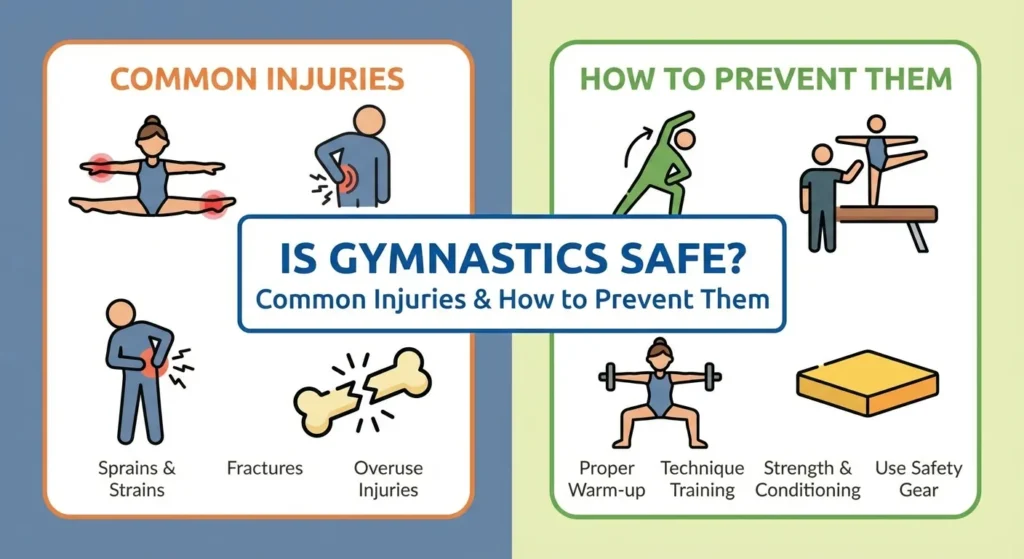
Is Gymnastics Safe? Common Injuries & How to Prevent Them
Learn about common gymnastics injuries and important safety principles.
How Many Hours a Week Should a Gymnast Train?
Understand how training frequency can change as a gymnast develops.
Adult Gymnastics for Beginners: It’s Never Too Late to Start
Gymnastics isn’t only for children. Learn how adults can safely begin training.
About the Author
Andrey Sovenko
Andrey Sovenko is a former Russian National Team gymnast, gymnastics coach and gymnastics club owner with decades of experience in the sport.
He competed on the Russian National Gymnastics Team from 2003 to 2008 and later spent more than a decade coaching gymnastics in the United States.
From 2016 to 2023, Andrey founded and operated a gymnastics facility that served approximately 500 students and included a team of approximately 10 employees.
Through Gymnastics Guide, he shares practical information about gymnastics training, beginner skills, equipment, safety and athlete development to help parents and athletes better understand the sport.
Learn more about Andrey Sovenko →
Sources & Expert Resources
For additional information about gymnastics safety, athlete development and supporting young gymnasts, parents can consult:
American Academy of Pediatrics / HealthyChildren.org — Gymnastics safety, injuries, supervision and athlete well-being.
USA Gymnastics — Parent Resources — Information for parents about athlete safety, wellness, communication and development.
USA Gymnastics Rules & Policies — Guidance on gymnastics attire and jewelry during sanctioned activities.
This article provides general educational information and is not a substitute for advice from your child’s gymnastics coach or healthcare professional.
Final Takeaway
Your child’s first gymnastics class doesn’t require complicated preparation.
Bring the basics:
Comfortable clothing.
Water.
Secured hair.
No unnecessary jewelry.
A positive attitude.
Then let the coach do what they do best — teach gymnastics.
As your child progresses, you may eventually need additional equipment, competition clothing, grips and other specialized items. But there is no reason to buy everything at the beginning.
Start simple. Choose a good gymnastics program. Support your child. Ask questions. And most importantly, let them enjoy learning gymnastics.