Beginner Gymnastics Classes: What to Expect
Starting gymnastics for the first time can feel exciting… and a little intimidating.
Will it be too hard?
Is it safe?
What if my child can’t keep up—or I feel totally lost?
The good news: beginner gymnastics classes are designed for complete beginners. You’re not expected to know anything on day one. Here’s exactly what usually happens in your first classes—and how to prepare so the experience is fun, safe, and motivating.
1. First Day: How Beginner Classes Really Start
Most beginner classes begin slow and structured. Coaches assume:
No prior experience
Limited strength and flexibility
Lots of questions
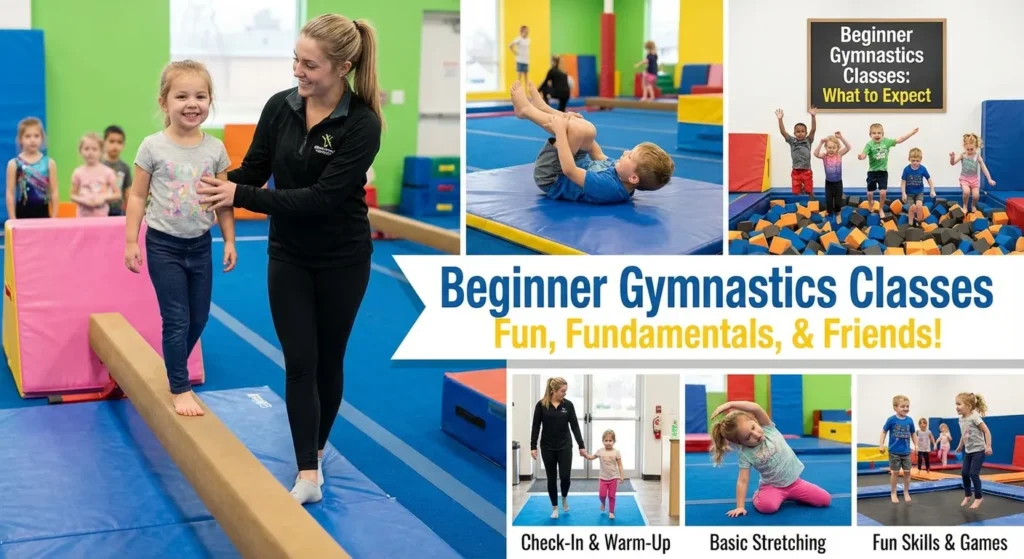
Typical first-class flow:
Roll call and quick intro
Basic rules (listening, safety, turns)
Light warm-up (jumping, jogging, stretching)
Very simple movements
No flips. No pressure. No comparisons.
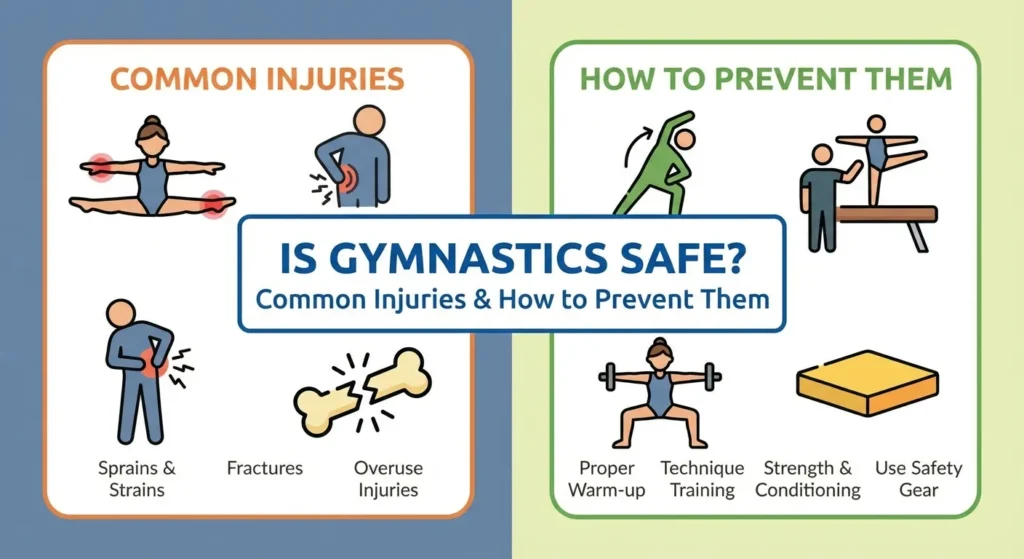
2. Warm-Up & Safety Come First
Warm-ups are a huge part of beginner gymnastics.
You’ll usually see:
Arm circles, leg swings
Light cardio (skipping, jumping)
Stretching hips, shoulders, ankles
Simple balance drills
This isn’t just “exercise”—it’s injury prevention.
Good beginner coaches repeat the same warm-up every class so students feel confident and comfortable.
3. Skills Taught in Beginner Classes
Beginner classes focus on foundational skills, not tricks.
Common beginner skills:
Forward rolls & backward rolls
Basic handstands (against a wall or with help)
Cartwheel progressions
Jumping and landing safely
Hanging and swinging on bars
Balance beam walking
Progress is slow by design. Mastery > speed.
4. Equipment Beginners Use
Don’t worry—beginners use soft, safe equipment.
You’ll likely see:
Floor mats and foam blocks
Low beams (close to the ground)
Low bars or straps
Trampolines (for coordination, not flips)
Everything is scaled to reduce fear and risk.
5. Class Structure & Coaching Style
Beginner classes are usually:
45–60 minutes
Small groups
Rotational (students move between stations)
Coaches:
Give constant reminders
Spot skills closely
Focus on encouragement
Celebrate effort, not perfection
If a gym pushes beginners too fast, that’s a red flag 🚩
6. How Progress Is Measured (Hint: Not by Tricks)
In beginner gymnastics, progress looks like:
Better balance
Improved coordination
Increased confidence
Stronger core and arms
Understanding basic shapes (tuck, hollow, straight)
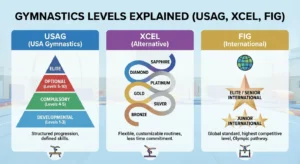
Many gyms use levels or badges, but early progress is mostly invisible—and that’s normal.
7. What Beginners Often Struggle With
This is completely normal:
Fear of being upside down
Weak wrists or shoulders
Trouble focusing
Comparing themselves to others
The key is consistency, not talent.
8. What to Wear & Bring
For beginners:
Leotard or fitted athletic clothes
Bare feet or gymnastics shoes
Water bottle
Hair tied back
No jewelry. No loose clothing.
9. How Long Until You See Results?
Most beginners see noticeable improvement in:
4–6 weeks: coordination & confidence
2–3 months: strength & basic skills
6+ months: clean fundamentals
Gymnastics is a long game—and that’s what makes it powerful.
Final Thoughts
Beginner gymnastics classes aren’t about being the best in the room.
They’re about learning how your body moves, building confidence, and enjoying progress—step by step.
If you know what to expect, you’re already ahead.